

Switzerland holds significantly more reserves relative to its GDP than the peer group average (37.8% of GDP)

| Rank | Country | FX Reserves (USD Trillions) | Reserves as % of GDP | Exchange Rate Regime |
|---|---|---|---|---|
| 1 | China | 3.450 | 19.7% | Managed Float |
| 2 | Japan | 1.295 | 29.4% | Free Float |
| 3 | Switzerland | 0.864 | 96.0% | Free Float |
| 4 | United States | 0.773 | 2.8% | Free Float |
| 5 | India | 0.628 | 15.3% | Managed Float |
| 6 | Russia | 0.597 | 31.4% | Managed Float |
| 7 | Taiwan | 0.493 | 75.8% | Managed Float |
| 8 | Saudi Arabia | 0.458 | 41.6% | Fixed Peg |
| 9 | South Korea | 0.421 | 26.3% | Free Float |
| 10 | Singapore | 0.360 | 40.0% | Managed Float |
🇨🇭 Switzerland’s $864 Billion FX Reserves: Power, Risk, and Global Impact
Switzerland holds $864 billion in foreign exchange (FX) reserves—96% of its GDP. That’s more than double Japan’s relative reserve size (29.4%) and over 30× that of the United States (2.8%). This makes Switzerland the most reserve-heavy economy in the developed world.
Why does a small, stable nation with just 9 million people need reserves nearly equal to its entire annual output?
🔧 Strategic Currency Management
The answer is the Swiss franc (CHF)—a global safe-haven currency. In times of crisis, investors flood into CHF, pushing its value higher. A strong CHF hurts Swiss exporters, who drive 70% of GDP. To counter this, the Swiss National Bank (SNB) intervenes by buying foreign currencies and selling francs—building massive FX reserves in the process.
From 2010 to 2025, the SNB’s balance sheet ballooned from $300B to $864B, primarily through these interventions.
📈 Benefits: Buffer, Stability, Competitiveness
- Export Support: A weaker CHF keeps exports (pharma, luxury goods, machinery) competitively priced.
- Crisis Insurance: FX reserves offer a war chest in global shocks.
- Investor Confidence: Large reserves enhance Switzerland’s financial credibility.
⚠️ Risks: Volatility, Losses, Political Pressure
- Valuation Risk: In 2022, SNB posted a $143 billion loss due to FX and equity revaluations—the largest in its history.
- Inflation: Currency interventions expand the money supply; sterilization is required to prevent overheating.
- Global Pushback: The U.S. has repeatedly placed Switzerland on its currency manipulation watchlist, citing its sustained current account surplus (above 10% of GDP) and one-sided interventions.
💱 CHF Impact: Artificial Suppression
Without intervention, the CHF would likely trade much stronger, damaging export margins. Instead, the SNB keeps it “lean” by absorbing capital inflows. This lowers volatility but suppresses natural market pricing.
🌍 Global Effects
- U.S. Impact: A weaker CHF means a relatively stronger USD—exacerbating U.S. trade deficits and inviting policy friction.
- Market Distortion: With nearly $1 trillion in assets, the SNB is a major global investor—holding U.S. tech stocks, eurozone bonds, and more. Its rebalancing decisions ripple through international markets.
🔍 NOK/CHF Outlook (1–3 Months) – Brief Summary:
- Direction: Bearish NOK / Bullish CHF
- Forecast: NOK/CHF seen falling from ~0.0790 to ~0.0758 (–4% downside)
📊 Drivers:
- Interest Rates:
- Norges Bank: 4.25% (holding, high inflation ~3.8%)
- SNB: 0% (cut in June; inflation low ~1.2%) → widening rate differential favors NOK, but CHF strength persists due to safe-haven demand
- Inflation Differential: Norway’s inflation remains higher → limits rate cuts, but CHF is more attractive in risk-off environment
- Technical Trend: Bearish for NOK/CHF – price below key MAs, negative MACD, RSI ~43
- Risk Sentiment: Favors CHF (safe haven)
| Feature | Norges Bank (Norway – NOK) | Swiss National Bank (Switzerland – CHF) |
|---|---|---|
| Policy Rate Name | Policy Rate (formerly known as Key Policy Rate) | SNB Policy Rate (previously the SNB Interest Rate) |
| Current Policy Rate (2025) | ~4.50% | ~1.25% |
| Inflation Target | Close to 2.0% | Below but close to 2.0% |
| Mandate | Price stability, financial stability | Price stability, while considering economic conditions |
| Main Policy Tools | Interest rate changes, FX market intervention | Interest rates, FX interventions, balance sheet tools |
| Exchange Rate Regime | Free-floating | Managed float, occasional interventions |
| Recent Policy Bias | Hawkish (focused on inflation containment) | Neutral to slightly dovish (inflation below target) |
| Last Policy Move (2025) | Held rates steady, signals potential for cuts | Cut rates by 25 bps in mid-2025 |
| Quantitative Tools | Limited use | Actively uses balance sheet when needed |
| Currency Intervention | Rare, only in extreme volatility | More active in FX markets to manage CHF strength |
✅ Strategy Bias: Short NOK / Long CHF over next 1–3 months.
| Factor | Long NOK / Short CHF | Short NOK / Long CHF |
|---|---|---|
| Technical Indicators | 🔴 Bearish – price below 50 & 200 SMA | ✅ Bullish – momentum and trend favor CHF |
| 1-Month Forecast | 🔴 ~–0.8% decline in NOK/CHF | ✅ CHF/NOK expected to rise ~0.8% |
| 3-Month Forecast | 🔴 ~–4% drop in NOK/CHF | ✅ CHF/NOK targeting ~13.2 (stronger CHF) |
| Moving Averages | 🔴 Bearish crossover (death cross) | ✅ CHF trending above key MAs |
| MACD / RSI | 🔴 Weak / Negative MACD, RSI < 50 | ✅ CHF gaining technical momentum |
| Central Bank Divergence | ⚠️ Norges Bank may pause cuts | ✅ SNB dovish bias continues |
| Oil Price Dependency (NOK) | ⚠️ Stable but not rallying – no NOK tailwind | ✅ Weak oil = weak NOK |
| Risk Sentiment (CHF = safe haven) | 🔴 Risk-on bias could help NOK (short-term) | ✅ Global uncertainty supports CHF |
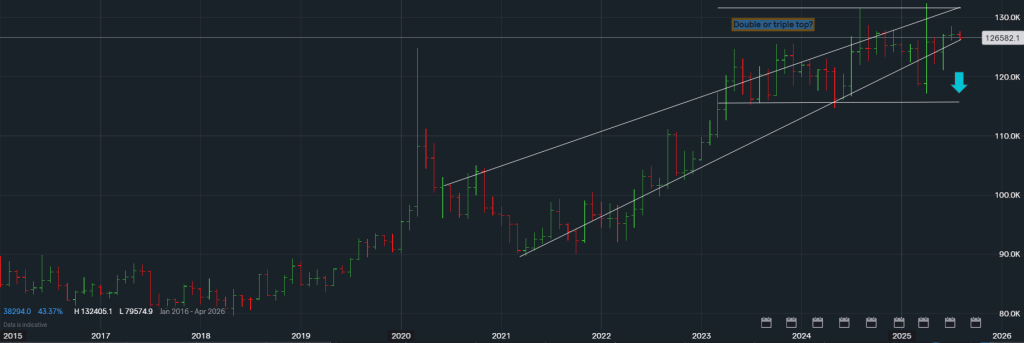
Tape reading => SHORT CHFNOK
📊 Final Word
Switzerland’s FX reserves are not just about defending the franc—they’re about defending a model: high exports, low inflation, and monetary independence. But with size comes risk. At 96% of GDP, even small shocks have big consequences.
As the global monetary system shifts, all eyes remain on the SNB—one of the world’s quietest, yet most powerful central banks.
 Agris F1